
Method 01
Core cutting services in Abu Dhabi, Dubai & Al Ain
Diamond core drilling from Ø25 to Ø600 mm through reinforced concrete, post-tensioned slabs, block and masonry. Every core is scanned and set out before the barrel turns.
What it is
When to specify core cutting
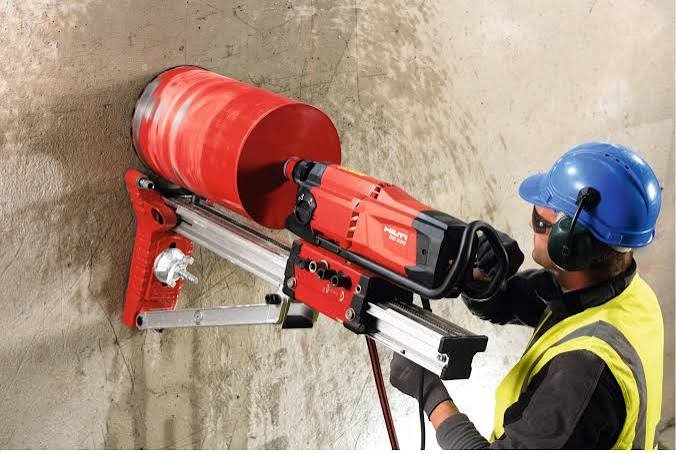
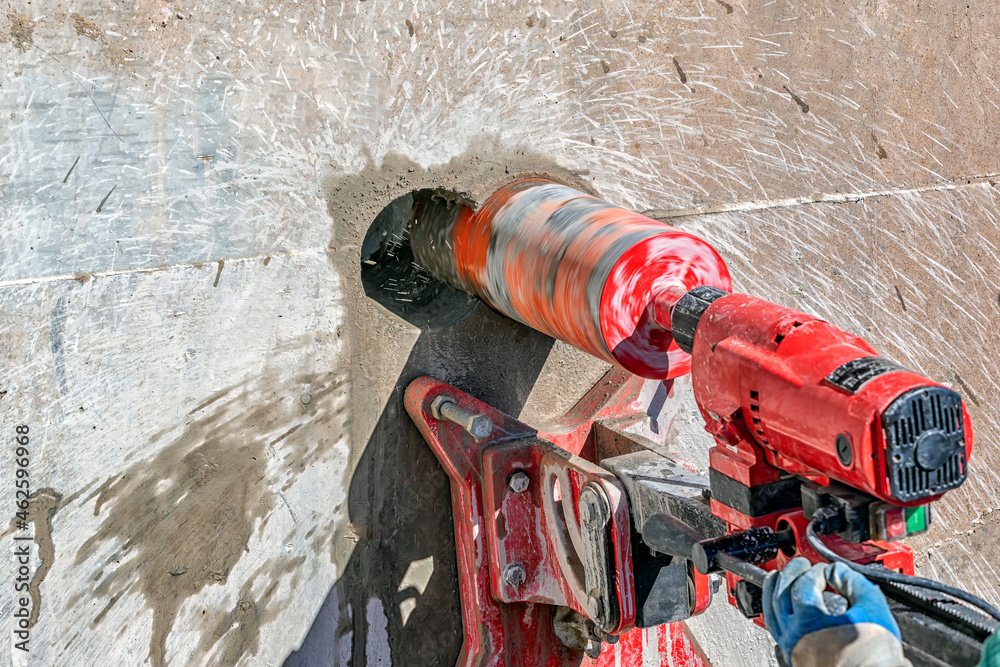
Core cutting, also called core drilling or diamond drilling, produces a clean cylindrical hole through concrete using a rotating barrel set with diamond segments. Water feeds through the barrel to cool the segments and flush the cuttings, which is why the method produces almost no dust and almost no vibration compared with percussive drilling.
Specify core cutting whenever you need a precise round penetration and the surrounding structure has to stay intact. Because the barrel cuts rather than hammers, it passes through reinforcement without spalling the surrounding concrete, without cracking finishes on the far face, and without transmitting shock into adjoining structure. On an occupied floor plate in Dubai or Abu Dhabi, that difference decides whether the tenant below notices the work at all.
The alternative methods have their place. If the opening is rectangular, wall or floor sawing is the right call. If the section is too thick for any blade, wire sawing takes over. Core cutting is the method for round penetrations, and it is also how a rectangular saw cut gets started, since corner cores give the blade somewhere to enter and exit cleanly.
Applications
What we use it for
MEP penetrations
Cores for chilled water, drainage, fire fighting, electrical conduit and ductwork through slabs, walls and beams.
Anchor and dowel holes
Precise holes for chemical anchors, starter bars and dowels where post-fixed connections must meet a pull-out specification.
Structural sampling
Core samples extracted for compressive strength testing, carbonation depth and chloride analysis, taken to lab requirements.
Handrail and balustrade fixings
Repeat cores at set centres for post fixings on balconies, stairs and terraces, drilled to consistent depth and plumb.
Stitch drilling for openings
Overlapping cores forming openings where saw access is blocked, and corner cores to start and finish saw cuts cleanly.
AC and ventilation cores
Through-wall cores for split unit pipework and extract, drilled with a fall to outside and sealed on completion.
Sequence
How the job runs
Set out and scan
Positions marked from your drawing, then scanned. Any core landing on rebar or a live service is flagged before setup.
Rig and isolate
Rig anchored or vacuum fixed, slurry ring fitted, area barriered. Below-slab side protected against core drop.
Drill and extract
Core drilled at controlled feed. The slug is removed intact and kept if you need it for testing.
Clean and hand back
Slurry vacuumed, edges made good, cores capped or sleeved if required. Photographic record issued.
Site control
Dust, slurry and waste control
Wet core drilling generates slurry, and slurry reaching a finished floor, a lift lobby or a drainage gully costs more to fix than the drilling cost to do. This is the part most contractors under-price and most clients only think about afterwards.
We fit a slurry ring to the barrel and run a wet vacuum on every core, bund the work area, and collect slurry into containers rather than letting it run. Slurry is removed from site and disposed of properly. On dry cores in occupied spaces we run class M extraction at the barrel.
On live buildings we also protect the underside. A 200 mm slug dropping through a soffit onto a ceiling grid is the most common avoidable incident in this trade, and it is prevented by catching the core rather than by hoping.

Related
Often quoted together
Questions